How our “Pioneer Texas Buildings” book project led us to Warrenton, and Our First Weekend Place in the Country
We were settled in at 201 Westmoreland with the office in the carriage house and now Clovis and I were able to spend more time on a project we had started when we first moved to Houston in 1964, but had not had time to really work on until now.
We had read in the paper a lot of things about barns and houses were being torn down in the country, because they were falling down and no one wanted an old house. At that time people wanted new houses. And so we got in the car and we drove around the Houston area, where Houston stopped it was just country. There were just cattle and old houses and barns and old buildings.
“Pioneer Texas Buildings” book project beginnings
We started just photographing the old buildings. We felt that a lot of these buildings could be saved but they were all being torn down. We picked the little towns in our area. Clovis knew the area outside of San Antonio so we would go around to New Braunfels, and that hill country area were Clovis spent time growing up and Clovis would do sketches and I would do photographs. We put this together before we ever talked about a book or anything.
We showed Diana Hobby what we were doing and she knew Frank Wardlaw and the University of Texas Press, and that’s how we ended up with a book project, but it started as just a way to try to save some old houses.
There were two things — one was that I did not really know anything about Texas, and the other is that we would find so much destruction of these old buildings in the country. We really just went around the hill country near San Antonio and the Central Texas area between Houston and Austin. We really didn’t go very far.
Looking for a Weekend Place in the Country
One Memorial Day weekend we put everyone in the car with cots and sleeping bags and an ice chest. Our friend who worked for the City of Houston had relatives who had inherited some property that had once been a dairy but now only had a vacant farmhouse and a couple barns at the end of a gravel road. She suggested that we could spend Memorial Day weekend there because we were looking for a place to go away for the holiday weekend, and she knew that we were interested in old houses in the country.
We had also talked to a couple of realtors who had told us about a couple of places in Schulenburg so we went there first, and those places were no attractive because they were right on the road and were not attractive. So we continued on to Warrenton.
The Warrenton Farm
We found the driveway and drove up a long dirt road to a little house with a barn behind it, and there was also a pond but I don’t think we saw that when we drove in. The grass was about three feet tall, because when we pulled up to the house, the cows all came to see what was going on. Clovis got out of the car, parted the grass with his hands so that he could walk to the house, but left us in the car because the cows by then had surrounded our car, probably thinking we had brought them something to eat.
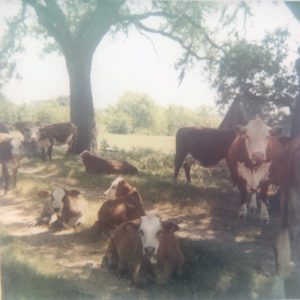
Eventually Clovis got the cows to move so that we could get out of the car and into the house, carrying our cots and sleeping bags and ice chest. We thought it was fabulous.
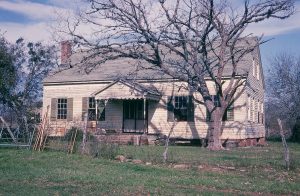
You walked into the center hall and and you had a bedroom on one side and the living room on the other side with a fireplace. There was a kitchen and an indoor bathroom, but it did not have any running water or anything.
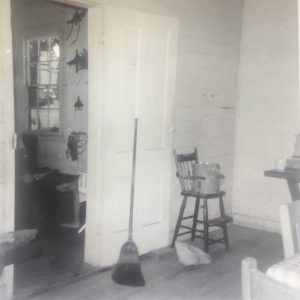
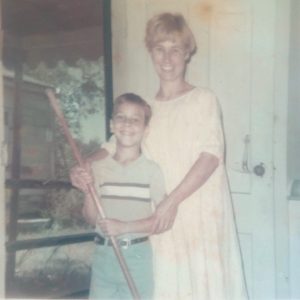
Clovis and Mary Elizabeth went to a local antique shop to buy some chairs, and Clovis went to a local store to call around until he found someone to come fix the pump so then we had running water in the faucets and could flush the toilets. Finding an old house in the country with actual working plumbing was very lucky. It was well water and if it tasted funny we didn’t notice it. We had a charcoal grate and we made hamburgers. There wasn’t a stove or anything like that. That first weekend there was no electricity, and we used kerosene lamps. In the morning we woke up to hear a buzzing sound in the walls, and it turned out to be bees.
Albert Buscher Store in Warrenton: a community center
We had stopped to buy gas and groceries at the Albert Busher store and that’s where we went for recommendations. They said to call the bee man and he would set up a hive next to the house and the bees would go in there, so we did and he did and they did. That’s what you did.
The Albert Busher store was our contact with civilization because they had a telephone and in those days there were no mobile phones or cell phones, so you had to go somewhere with a real telephone to make a phone call.
Also the Albert Buscher Store had a jukebox. You could get cold drinks and the children liked to put nickels in the jukebox and play “Groovy Grubworm” and dance. Also “I’m Henry the Eighth I am.” Imagine all our children dancing and singing, “I got married to the widow next door, she’d been married seven times before and every one was a Henry, Never chose a Willie or a Sam. And right old boy I’m Henry, Henry the Eight I am I am, Henry the Eighth I am!” I had forgotten that until just now.
They also knew who to call because that was the local store so everyone knew everybody. Warrenton was a very small community and we were a great curiosity.
Fayetteville, John Cufr, Saint John’s Catholic Church, and Father Ben
Fayetteville is the nearest town to Warrenton and that’s where the Catholic church was. Clovis was very good at meeting people and he had stopped by John Cuff’s store because it was on the square and it was open. Cufr’s had all kinds of work clothing and farm clothing, so we all got outfitted for the country and later when friends would visit we would send them there to get clothes for working and country living. Clovis found out what time Sunday Mass was, and John Cufr told him he should go by and meet Father Ben.
Father Ben had been in Fayetteville a pretty long time. The priest before Father Ben used to live in the house up near Saint Mary’s. Father Ben liked fishing and I think hunting. He reminded me of the priest in the John Wayne movie, “The Quiet Man.” Father Ben talked with us about the old church. The roof leaked and if it was raining and you sat in the wrong pew you would get wet.
That first weekend in Warrenton we got everyone in the car on Sunday morning and we went to Mass at St. John’s in Fayetteville. The church was no air conditioned so the windows were open and they left the door open. There were even little cardboard fans on sticks with holy card pictures you would fan yourself with.
The Pond at our Warrenton Farm
We convinced ourselves there were not any snakes in the pond and so we decided to swim there. It was deep enough to be a really good place to dive in and swim which was really nice. We made a rope swing so you could swing out from the tree and drop into the pond. We had ski belts for the children for safety. The edge of the pond was very muddy. It was created to provide a place for the cattle to drink, not intended for recreation but it was a great swimming place.
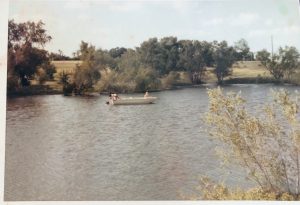
Renting our Weekend Place in the Country
When we went back to Houston we told our friend we’d like to rent this place to go for weekends and so for three years I would mail a check for I think $35 each month and we could get the place every weekend.
Spending weekends in Warrenton we had parties, inviting friends from Houston to join us. It’s important to remember that when our friends came out to visit us in Warrenton when we had parties they had to drive home to Houston that night because there were no bed and breakfasts or even a motel for them to stay nearby.
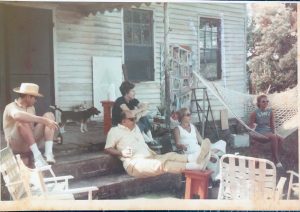
You can see in the picture above, the masonite nailed to the outside of the house, next to the porch. This is where Clovis would paint. He used acrylic paint and would be able to paint large pictures on the masonite. At the end of the weekend, he would load his paintings in the car and bring them back to Houston. We always carried a bunch of stuff back and forth in our station wagon: paintings, sheets, towels, all loaded in a big laundry basket, and then we would all get in the car – two adults and five children, and we always had a dog (Ophelia) and sometimes a cat.
If we can find a picture of the car, it goes here. We would listen to John Denver, Neil Diamond, and Cat Stevens on the eight track tape while we were diving.
Clovis was able to put dropcloths on the floor, set up his easel, and paint. The children painted, too. We did not need to worry about making a mess, because it was easy to clean up, and less worry about breaking or spilling, compared to our 201 Westmoreland house in Houston. And we could let the children run around, play, and explore.
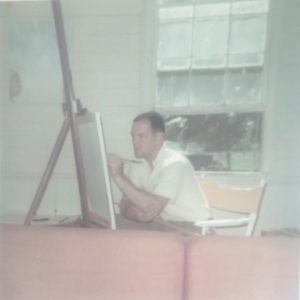
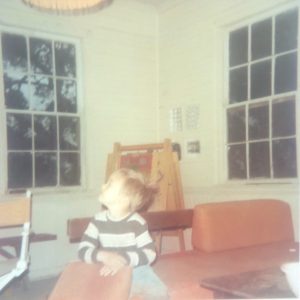
As a family we did creative art projects, and we got to know the local area, especially Fayetteville. Clovis even made a short film, “John Goes to Fayetteville,” for his film class at University of St. Thomas.
Editor’s Note ====>>> Find the link to “John Goes to Fayetteville” film – it is somewhere online?
Another film we made as a family, using paper plates to make masks, is on Super 8 somewhere in a box, I will find it and put a link here.
End of our rental arrangement, need to find a new Weekend Place in the Country
When the children of the people who owned the Warrenton place realized that it was a really fun place to spend weekends, they wanted to have it for themselves and so their parents told us they could no longer rent it to us.
After leaving Warrenton we tried spending weekends at the Heimsath ranch in Medina, but that lasted about two months before we realized it was just too far away — five hours in each direction — and it did not belong to us, it belonged to Clovis’s parents and so any changes we made to the furniture arrangements would need to keep in mind the other family members who might want to use the place. Several times we invited our friends and our cousins to Medina for a weekend party, using the ranch the way we would use the Warrenton house, and it was not as good a setup, but we still had a lot of fun. I remember best swimming in the Medina River, sitting on the big rocks. It was beautiful. Clovis would paint and our kids really enjoyed being there — they liked to climb the mountains and collect fossils and be careful not to get bitten by a rattlesnake or a scorpion. I think I was more worried about that than anybody else was.
Once we decided we really needed a country place closer to Houston, and Medina was too far away, we went back to Fayetteville to look for a weekend place and wanted to see what was available. While we were working on Pioneer Texas Buildings we made a number of visits to Fayetteville, and that’s when John Cufr mentioned to us that the former mayor had a house on the other side of the railroad tracks that might be available. But that’s the next chapter.